



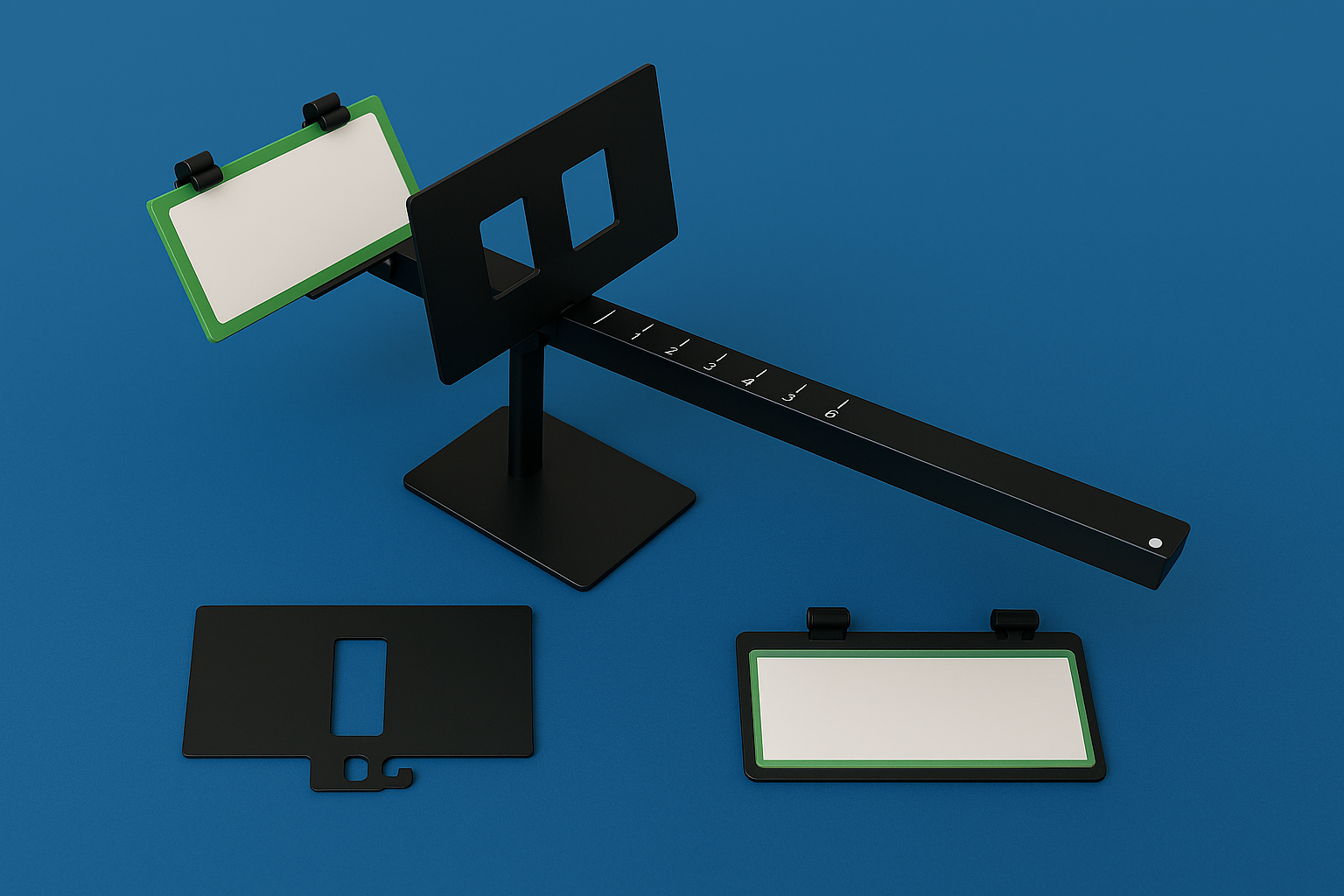
Aperture Rule, developed by Vodnoy in 1956 is an active vision therapy tool, used to train and strengthen vergence and accommodation and the interaction between the two. It consists of single and double apertures as seen in diagrams below. When single aperture is used, the visual axes cross at a distance closer than the viewed targets, making your eyes cross inward (convergence) or creating BO fusion demand. Similarly, when the double aperture is used, the visual axes cross at a distance farther away than the viewed targets, making your eyes relax outward (divergence) or creating BI demand.
HOW TO USE APERTURE RULE
- The instrument is placed on a table at a comfortable height with good lighting.
- A flip booklet (with target cards) is placed at the “0” mark on the back of the ruler.
- Each card has two targets: one seen by the right eye, the other by the left eye.
- Open the booklet to show the first card (AP1).
- There’s an aperture on the front part of the ruler at marks “1” and “2”.
- The patient places their nose at the edge of the ruler, keeping it centered between their eyes.
- Targets are viewed by looking through the aperture(s).
- To align properly, the patient should close one eye at a time to check the target is seen correctly.
- The therapist can also check for suppression (with special signs above and below small circles).
- The patient tries to fuse (combine) the two targets into one image.
- Mental techniques might be needed (forcing eyes to turn inward or relax outward).
- Each new card (AP1 to AP12) makes the task harder.
- As difficulty increases, the aperture slider is moved to match the new card number.
- As the target difficulty increases, the aperture slider is moved to match the number on the card.
- Example: For card AP3, move the slider to “3”; for AP4, move it to “4”.
- Each card has a different prismatic demand (how much the eyes have to work).
- The card number tells how far apart identical points are (in centimeters).
- To find the prism demand, multiply the card number by 2.5.
- Example: AP1 = 2.5 prism, AP12 = 30 prism.
- Vodnoy suggested aiming for card AP7 for divergence training.
- Some patients may be able to go beyond AP7 when practicing divergence.
HOW DOES APERTURE RULE WORK?
1. Chiastopic Fusion – Improving Convergence
Goal: Train the eyes to turn inward (converge) and fuse two targets into a single, clear image.
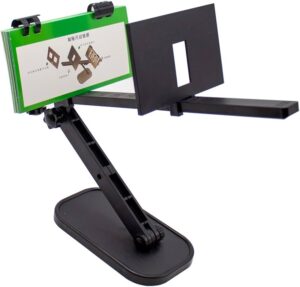
Procedure Steps:
- The patient looks through the aperture and tries to merge two targets into one.
- If struggling:
- A small mark is placed above the aperture—the patient focuses on it first, then shifts attention to the target.
- A pointer can be used to guide convergence to the correct depth.
- Closing and opening the eyes repeatedly (cross-convergence technique) may help trigger fusion.
- Additional cues (like marks near the ears) can assist if fusion is still difficult.
- Once fused, the patient should check:
- Is the target clear?
- Are both suppression checks (likely peripheral markers) visible? (Ensures no eye is being suppressed.)
- Is there depth perception in the rings? (Indicates proper 3D vision.)
- If the target is blurry:
- The patient should keep eyes converged but try to focus (accommodate) on the target plane.
- Slow blinking helps clarity; rapid blinking can break suppression.
- Progression:
- Hold fusion for longer durations (10-15 seconds).
- Increase difficulty with base-out (BO) prismsor plus lenses to demand more convergence.
2. Chiastopic Fusion – Jump Vergence
Goal: Improve the ability to quickly and accurately shift focus between near and far targets.
Procedure Steps:
- The patient alternates fixation between:
- A pointer (near target).
- The fusion target (far target).
- Repeat 10 times, ensuring:
- Quick, smooth shifts.
- No blur or suppression.
- Can also use other objects in the room as additional jump points.
3. Orthopic Fusion – Improving Relative Divergence
Goal: Train the eyes to turn outward (diverge) while maintaining fusion.
Procedure Steps:
- The patient views targets through a double apertureand tries to diverge.
- If struggling:
- Look past the target at a distant object (e.g., a pointer placed far away).
- Notice the target in the foreground, then slowly shift gaze back.
- Once fused, check for:
- No suppression.
- Depth perception in rings.
- If blurry:
- Repeat the exercise with slow blinking.
- Base-in (BI) prismsor minus lenses can increase difficulty.
- Progression:
- Work toward fusing higher-demand targets (up to 17.5Δ divergence).
4. Orthopic Fusion – Jump Vergence
Goal: Quickly regain fusion after breaking it, improving flexibility in divergence control.
Procedure Steps:
- The patient:
- Closes and opens eyes repeatedly to re-establish fusion.
- OR shifts focus to a distant object and back.
- Repeat 10 timesuntil smooth and effortless.
Key Concepts & Techniques
✔ Fusion: Merging two images into one (needed for 3D vision).
✔ Suppression Check: Ensures both eyes are active (no “turning off” one eye).
✔ Slow Blinking: Helps clear blur.
✔ Rapid Blinking/Covering an Eye: Breaks suppression if one eye is being ignored.
✔ Prisms/Lenses: Used to increase difficulty (BO for convergence, BI for divergence).
✔ Progressive Training: Start easy, hold longer, then add challenges.
This therapy is likely used for conditions like convergence insufficiency, divergence excess, or binocular vision disorders. The goal is to improve eye coordination, depth perception, and visual comfort.
This article was written by Akriti KC.
