



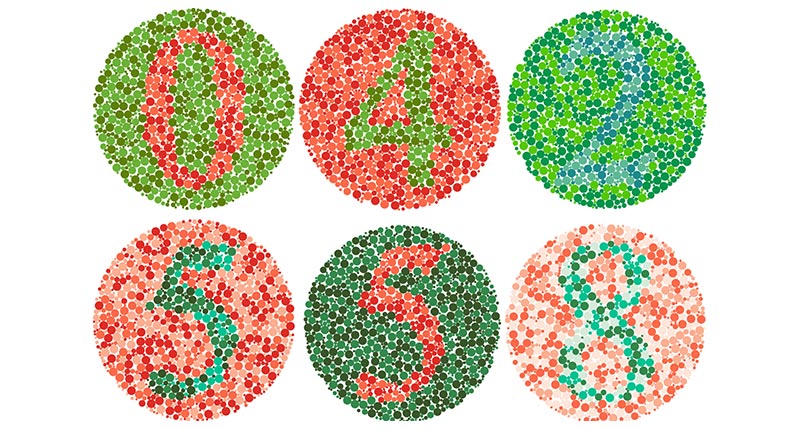
Color vision deficiency, commonly known as color blindness, is a condition that affects how a person sees and distinguishes various colors. This happens when the light-sensitive cells in our eyes, called cones, are either missing or not working correctly. These cones in the retina are responsible for detecting red, green, and blue light. Because of this deficiency, a person might have trouble telling the difference between certain colors, most often red and green. While it might seem like a major problem, most people with this condition lead normal lives and don’t even realize they have it until they take a specific test.
The ability to perceive different colors is called color vision. The retina in our eyes contains special cells called cones that help us see colors. People born with a deficiency of these cells may have a red, green, or blue color vision defect.
Frequently Asked Questions on Color Vision Defects
1. Is a color vision defect curable?
People born with deficient cone cells have no cure. But there are a few methods where their color perception can be enhanced. Color vision deficiencies caused by underlying diseases can often be corrected once the disease is properly treated.
2. How can I know if I have a color vision defect?
There are certain tests available to assess color vision. The Ishihara test is the most commonly used clinical method to detect red-green color vision deficiencies. Online versions of this test are widely available.
3. Can it be genetic?
YES, congenital color vision defect is genetic and males are significantly more likely to be affected than females. About 1 in 12 men and 1 in 200 women have some form of color vision deficiency.
4. How do people with a color vision defect perceive colors?
Individuals with color vision problems caused by a deficiency of certain color cells tend to perceive colors as less vibrant and may confuse two similar shades of red or green. For example, having difficulty distinguishing between lighter tones of these red-green colors.
Those who completely lack specific cone cells are unable to perceive the corresponding color altogether.
5. Does a color vision defect affect my daily work?
Most individuals are unaware they have a color vision defect until they’re required to take a color vision test—often prompted by specific job requirements that prioritize accurate color perception.
So, normally, a color vision defect does not hamper daily activities (except with acquired color vision defect due to diseases).
6. When is a color vision defect an issue?
Professions like Pilot/Navigation personnel, military, and police officers do not recruit people with color vision deficiency.
Careers like chemistry, electrical work, painting, and similar fields can be challenging for those with color vision issues, and some countries enforce strict policies against hiring individuals with such conditions.
7. Can I get a driver’s license with a color vision defect?
It depends on the country’s policy. In developed countries, a mild color vision defect poses no difficulty in getting a driver’s license.
In a country like Nepal, the Transport Management Act 2049 states that a person is not eligible to drive if they cannot distinguish red, green, or yellow. However, there is ongoing debate about this law, with many officials and experts believing it should be amended.
8. Can color vision defect be enhanced?
Sadly, there is not really a cure for color blindness and inherited color deficiency. But there are a few lenses and glasses that aid in color detection, like X-Chrom lenses and EnChroma glasses.
X-Chrom Lenses
- X-Chrom contact lenses are red-tinted soft lenses that may help users distinguish colors on standard color vision tests.
- They do not correct color vision deficiency or restore normal color perception—they only alter how colors are perceived.
- Not FDA-approved as a treatment for color blindness and not accepted for occupational color vision testing (e.g., aviation, military).
- Primarily used during testing; not suitable for regular daily use due to visual discomfort.
EnChroma Glasses
- EnChroma glasses are designed to enhance color perception for people with red-green color deficiency using special lens technology.
- They do not cure color blindness—they only help some users see colors more distinctly while wearing the glasses.
- They do not work for people with complete color blindness or blue-yellow color blindness.
9. Is color vision really necessary?
- Usually, color vision defects don’t affect everyday life.
- However, they limit career choices in fields requiring accurate color perception (aviation, military, technical jobs).
- Early testing is important to help individuals make informed career decisions and avoid disappointment later.
Written By: Aakriti K.C.
