




If you’re searching for “D to mm converter keratometer“, “how to convert keratometer readings“, or “corneal curvature diopters to mm“, you’re in the right place! This guide explains how keratometers convert radius (mm) to diopters (D), why the 1.3375 refractive index is used, and how to do the calculations manually and using our online converter for Diopters to mm.
Why mm to D or D to mm Keratometer Conversion is useful?
- Optometrists & Ophthalmologists – Need accurate conversions for corneal power.
- Contact Lens Fitters – Use keratometry readings for lens selection.
- Medical Students – Learning keratometry principles.
- Refractive Surgeons – Planning LASIK, PRK, or cataract surgery.
- Researchers – Studying corneal biomechanics.
How Does a Keratometer Convert mm to Diopters?
A keratometer measures the anterior corneal curvature in millimeters (mm) and converts it to diopters (D) using a simplified formula:
Keratometer Formula:
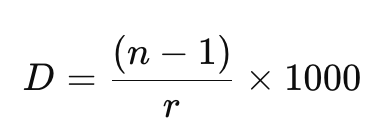
D = Corneal power in diopters
n = Keratometric refractive index (1.3375 by default)
r = Radius of curvature in millimeters (mm)
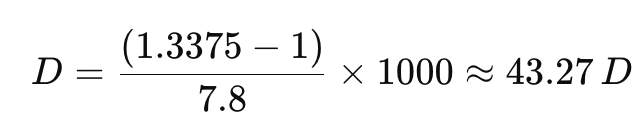
Example Calculation: If a keratometer reads 7.8 mm, the conversion is:
Why Is the Refractive Index 1.3375 in Keratometry?
The standard 1.3375 value is used because:
- Simplifies calculations by accounting for both anterior and posterior corneal curvature.
- Mimics the net refractive power of the cornea.
- Industry standard – Ensures consistency across devices like Zeiss, Nidek, and Topcon keratometers.
Diopter to MM Conversion
You can also convert diopters back to mm using:

Diopters to Radius Conversion Chart
A conversion chart helps visualize the relationship between corneal power (D) and radius (mm):
Higher diopters → smaller radius → steeper cornea
Lower diopters → larger radius → flatter cornea
Common Keratometry Applications
Contact Lens Fitting – Flatter corneas need lower base curves.
IOL Power Calculations – Critical for cataract surgery formulas.
Keratoconus Detection – Steep corneas (>48 D) may indicate pathology.
FAQs About Keratometer mm to D Conversion
1. Can I use 1.336 or 1.340 instead of 1.3375?
Some devices allow adjustments, but 1.3375 is standard.
2. How do I convert diopters back to mm?
Use the formula:
3. Does corneal thickness affect readings?
Indirectly—keratometers assume standardized corneal curvature. Pachymetry is needed for precision.
Keratometer D to mm Converter or mm to D Online Converter
Keratometer Converter
Formulae: D = (n − 1) · 1000 / rmm and rmm = (n − 1) · 1000 / D. For standard keratometry, n = 1.3375 so the constant is ~337.5.
