



Many eyeglass wearers in Nepal struggle with thick, heavy lenses—especially those with high prescriptions. Fortunately, high index lenses provide a solution that offers both functionality and style. In this blog, we’ll explore what high index lenses are, who they’re for, and highlight the arrival of Tokai Optical’s Made In Japan ultra-thin 1.70 and 1.76 index lenses—now available in Nepal.
Table of Contents
What does lens index mean?
Lens index means the refractive index of a lens. The Refractive index of a material is a dimensionless number that tells us how fast the light travels through the material. In other words, the index of the lens is the ratio of the speed of light in a vacuum divided by the speed of light in the lens material. Ophthalmic lenses typically range from 1.50 to 1.76 in refractive index.
Some Refractive Index values:
| Material | Approx. Refractive Index (n) | Notes |
|---|---|---|
| Vacuum | 1.0000 | Defined standard (light travels at full speed) |
| Air | 1.0003 | Close to vacuum; varies slightly with temperature, pressure, and humidity |
| Water | 1.333 | Common value at room temperature (20°C) |
| Crown Glass | ~1.46–1.52 | Regular optical glass (often used in lenses) |
| Flint Glass | ~1.6–1.9 | Higher dispersion, used in more advanced optics |
| Diamond | 2.42 | One of the highest naturally occurring indices; strong internal reflection |
What are High Index Lenses?
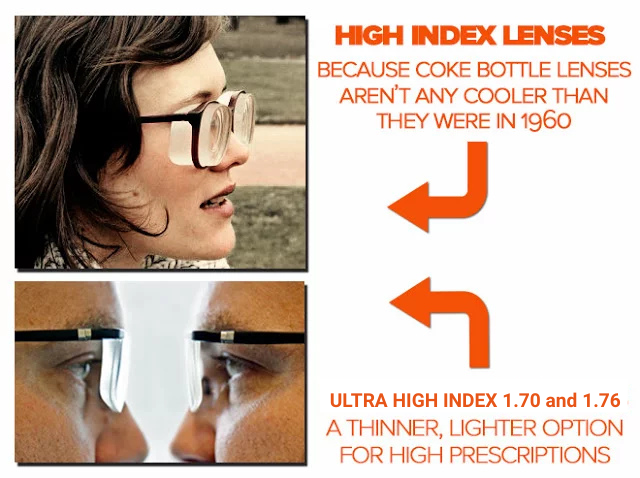
High index lenses are those lenses whose refractive index of the lens is higher than the common ordinary lenses having a 1.50 index. Ophthalmic lenses with a refractive index of 1.60 and above are considered high index lenses. These are commonly available in 1.60, 1.67, 1.70, 1.74, and now 1.76 indexes.
In summary, the Higher the index thinner will be the lenses and the lower the index of lenses thicker will be the eyeglasses lens.
Available Index Options:
| Lens Type | Refractive Index | Thickness & Weight | Best For |
|---|---|---|---|
| Standard Plastic | 1.50 | Thickest, heaviest | Low prescriptions, budget option |
| Mid-Index | 1.56 | Slightly thinner | Mild prescriptions |
| Polycarbonate | 1.59 | Impact-resistant, lightweight | Safety glasses, kids’ frames |
| Super-Thin (1.60) | 1.60 | 20-30% thinner than standard | Moderate to high prescriptions |
| Ultra-Thin (1.67) | 1.67 | 40% thinner | High myopia/hyperopia |
| Tokai 1.70
1.74 Index |
1.70
1.74 |
Thinner than 1.67, high clarity
Thinner than 1.67 |
Strong prescriptions, better optics
Strong Prescrpition |
| Tokai 1.76 (World Thinnest) | 1.76 | Up to 50% thinner than standard | Extreme prescriptions, minimal edge thickness |

In summary:
Higher index = Thinner lenses
Lower index = Thicker lenses
Patients with high plus prescriptions may experience a bulging-eye appearance due to thick lenses, while those with high minus prescriptions may find their eyes appear smaller and their facial features distorted. These effects are undesirable. High-index lenses help reduce this appearance, offering a more natural look.
Benefits of High Index Lenses
- Thinner lenses: Reduce the bulky “bottle-cap” effect for strong prescriptions
- Lighter weight: More comfortable to wear all day
- Better aesthetics: Slimmer lenses fit better in modern frames
- Improved vision: High clarity with less distortion
- UV protection: Many come with built-in UV blocking
Who Should Choose High Index Glasses?
- People with prescriptions stronger than +/- 2.00
- Those who want to avoid thick, heavy lenses
- Individuals looking for stylish, slim eyewear
- Anyone wanting comfortable glasses for daily wear
Which Lens Index Should You Choose?
High-index lenses are best for people with moderate to strong prescriptions:
| Prescription (SPH) | Recommended Index | Why? |
|---|---|---|
| Below ±4.00 | 1.60 | Good balance of cost and thinness. |
| ±4.00 to ±8.00 | 1.67 or 1.70 | Thinner than 1.60, better optics. |
| ±8.00 and above | 1.74 or 1.76 | Maximally reduces edge thickness. |
Note:
-
1.70 (Tokai Lens From Japan) offers better clarity than 1.67.
-
1.76 (Tokai Lens From Japan) is the thinnest available, ideal for extreme prescriptions.
Why Choose High Index Lenses?
Advantages:
- Up to 49% thinner than standard lenses (1.50 Vs 1.76 AS Tokai Lens)
- Lighter weight enhances comfort
- Reduces “bulging eyes” effect (in high-plus prescriptions) and “tiny eyes” (in high-minus prescriptions)
- Pairs well with modern, slim frames
- Available with UV protection and anti-reflection coatings.
Disadvantages:
- Higher cost due to advanced materials, Scratch Resistant Coating and AR Coating
- Less impact-resistant than polycarbonate. Not Suitable for Sports player and child.
Choosing the Right Frames for high prescription
When you have a high prescription, it’s very important to choose a frame that provides you best style and comfort. If you have a strong power prescription the rimless frame may not be the best option for you even with a high index lens. The best frame for high power is a small rounded frame or an oval frame, which provide better fitting of the lens as well as minimize the distortion caused by the lens with higher prescription.
Where to Buy High Index Glasses in Nepal?
When buying high index lenses, always choose a trusted optical shop, eye clinic, or eye hospital that offers premium lens brands and gives you personal consultation.
High index lenses are not like regular lenses. They need:
- Accurate power measurement
- Correct frame selection
- Precise optical center marking
- Right coating based on your lifestyle and vision needs
These steps are very important and should be done by qualified eye care professionals.
❌ Do not buy high index lenses from online marketplaces. Online sellers may not take proper measurements or give you the right advice for your eyes.
What to Check Before Buying these Lenses:
- Ask for the authenticity or quality card that comes with the lens.
- Make sure the lens comes with a original packaging.
- If in doubt, ask to see the lens packet showing your power.
- Confirm that the optical shop, clinic, or hospital is an authorized retailer of that brand.
Be careful with cheap or unbranded lenses. These may look similar, but they often have weak coatings, no UV Protection, and fake or missing labels.
High index lenses are thinner, lighter, and more comfortable—a great upgrade for your glasses. Talk to your eye care professional today to find the best index lens for your eyes and lifestyle.
